
In this guide
When you pay Statutory Maternity Pay (SMP), you may be able to recover most or all of the statutory amount through payroll. The recovery rate depends on your business's Class 1 National Insurance record. Paying the employee and recovering the money are separate steps; advance funding may help where there is a cash gap.
What can you recover?
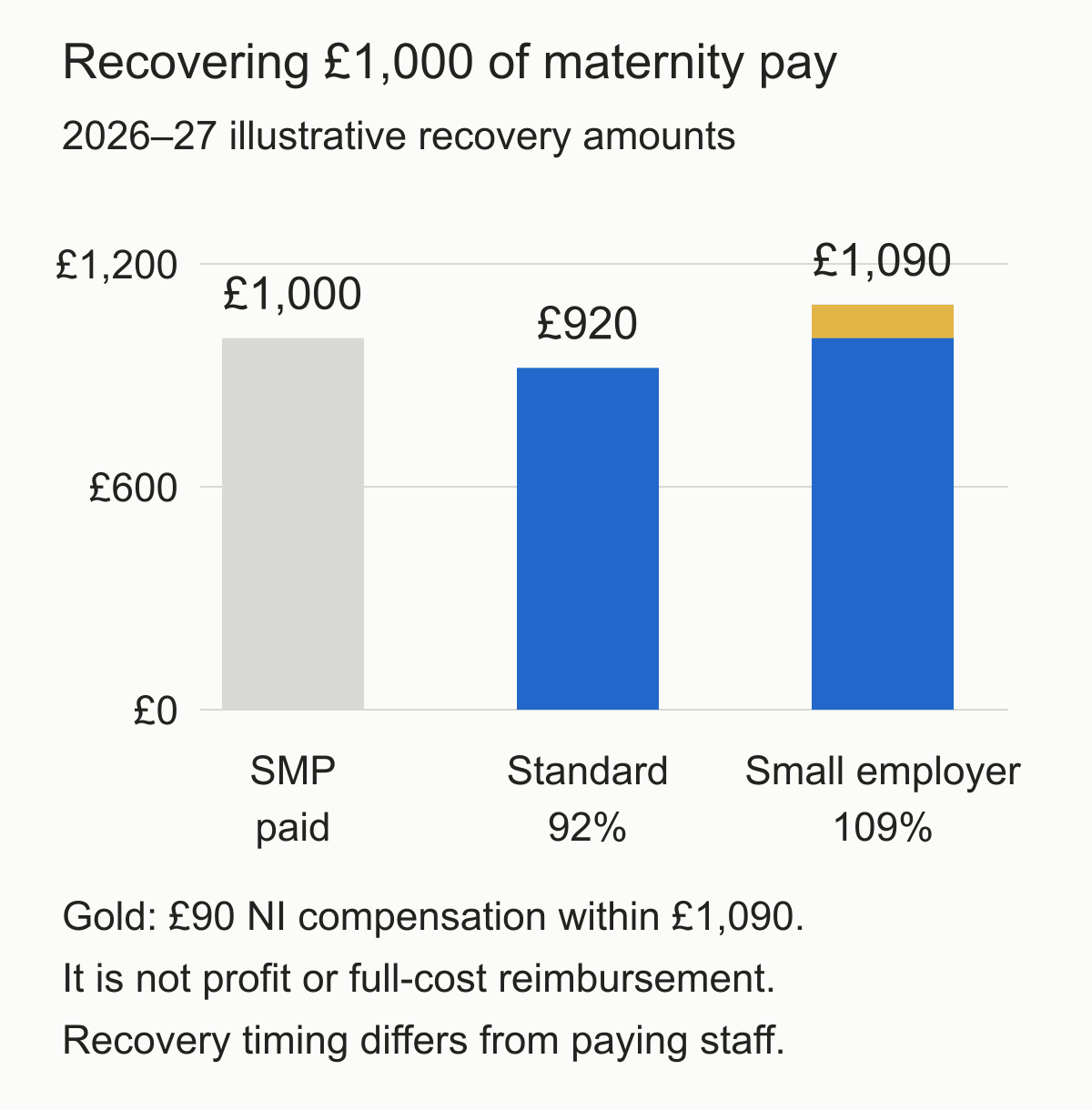
Most employers can reclaim 92% of SMP paid. A business may qualify for Small Employers’ Relief if its total gross Class 1 National Insurance contributions, including both employer and employee contributions, were £45,000 or less in the last complete tax year before the employee’s qualifying week. Ignore reductions such as Employment Allowance when checking this threshold. Qualifying employers can recover 100% of the statutory pay, plus compensation. For 2026/27, that compensation is 9%, making the total recovery 109% of the SMP amount.
For example, suppose your payroll pays £1,000 of SMP. At the 92% rate, you could reclaim £920, leaving £80 of the statutory payment unrecovered. At the 109% Small Employers’ Relief rate, the recovery would be £1,090: £1,000 of SMP plus £90 compensation. That extra £90 is a statutory contribution towards employer costs. It is not a profit figure and does not show that every cost connected with absence is covered.
These rates concern employer recovery. They do not change the employee’s SMP entitlement or the amount they should receive. Check that entitlement, dates and payroll calculation separately using HMRC’s employer guidance.
Claim through payroll
Record the SMP paid and report the reclaim in an Employer Payment Summary (EPS). Send the EPS for each tax period in which you reclaim statutory payments, including when HMRC has already provided advance funding. The reduction is set against amounts due to HMRC. If there is not enough PAYE or National Insurance to offset, HMRC says you can ask for repayment after the tax year ends.
That timing can leave a gap between paying an employee and getting the cash back. Estimate the SMP due across the relevant pay periods, then compare it with the PAYE, National Insurance and other deductions available to fund it. If you cannot afford the payments, you can apply to HMRC for advance funding. Apply up to four weeks before you need the first payment; HMRC decides the application, so do not treat an advance as guaranteed cash.
Keep the employee’s dates, SMP calculation, payroll records, EPS submissions and any advance-funding correspondence together. Ordinary Statutory Sick Pay is not recoverable through this scheme.
Check HMRC's advance-funding instructions before applying. The example does not calculate an employee's entitlement or the employer's full absence costs.
For the employee-side payroll process, see Statutory Maternity Pay through payroll and our PAYE and payroll guide. Swift’s Payroll and Pensions service can discuss employer payroll support within an agreed scope.
Need help running payroll?
Run payroll and agreed pension tasks to a set timetable, with employee changes and approvals tracked each pay period. We agree the scope and fee before work starts.
Discuss your payroll